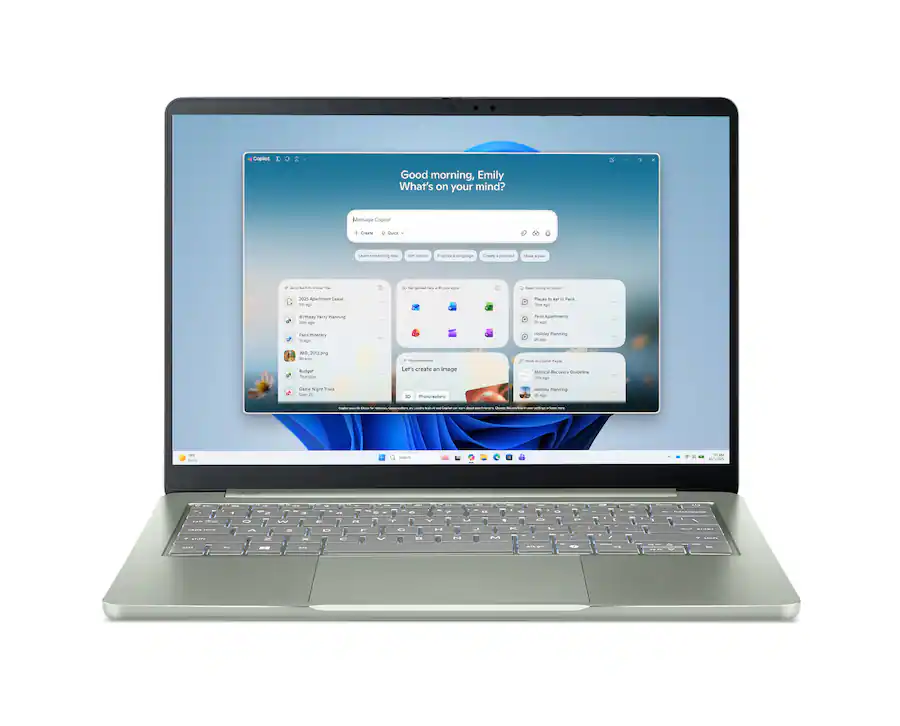
The Acer Swift Air 14 is another attempt to bring a premium-feeling laptop experience down to around the $700 mark. Like Dell’s XPS 13 and Apple’s MacBook Neo, it targets buyers who want a laptop that can do the basics: web browsing, office work, video calls, and other light tasks.
With these laptops, it comes down to whether you prioritize build and display quality or longer battery life, a more comfortable keyboard, and a better selection of ports.
A Fun Design, but Less Premium Build Quality
The Swift Air 14 looks good, particularly in its pastel color options. Acer offers Sage Green, Frost Blue, Blossom Pink, and Lilac Purple. Our Sage Green model is attractive, although it borders on gray. The brighter pink, blue and purple options stand out a little more.
The chassis is metal and feels cohesive, but it isn't as rigid as the XPS 13 or MacBook Neo. The keyboard deck flexes noticeably while typing, and the lid has some give when pressed while closed. It does not feel flimsy or cheap, but buyers coming from a MacBook or another higher-end laptop may notice the difference.
The upside is weight: despite having a larger 14-inch display than the XPS or Neo, the Swift Air is still very light and relatively compact.
Acer has also rounded off the front edge of the chassis rather than leaving it sharp. That makes it more comfortable to use without arm support, such as on a plane. The front notch also makes the lid easy to open with one hand.
A Good Enough 120Hz Display
The Swift Air uses a 14-inch IPS display with a 1920 x 1200 resolution and 120Hz refresh rate. The resolution is lower than on the XPS 13 or MacBook Neo, so text and other fine details do not look quite as sharp. However, 1920 x 1200 is still common at this price point and screen size.
Even so, the display still has several pros. The panel reaches nearly 400 nits of brightness, covers about 99% of the sRGB color gamut, and has a fast 120Hz refresh rate.
We also didn't notice any obvious quality issues, such as backlight bleed. The matte finish is particularly useful in brighter environments because it reduces reflections. The MacBook Neo has a glossy panel that gets significantly brighter, so the two approaches mostly balance out for visibility.
Overall, this is not an exciting display, but it is more than good enough for basic productivity.
One of the Better Keyboards at This Price
The keyboard is one of the Swift Air’s stronger features. It has 1.3mm of key travel, which is more than you get on many budget laptops and also more than the XPS 13 or MacBook Neo.
Whether you prefer it over Apple’s keyboard will come down to personal preference. The Swift has longer travel and requires slightly more force to press. The Neo feels clickier and has a sturdier keyboard deck.
We preferred the Swift’s longer travel, although the deck flex makes the typing experience feel slightly mushy at times.
Another advantage is backlighting. Unlike the MacBook Neo, the Swift Air’s keyboard is illuminated, which makes it much easier to use in darker environments on long study nights.
Basic but Decent Trackpad
The trackpad gets the job done. Tracking feels smooth and natural, while the mechanical click is accurate. Clicking is a little deeper and louder than we would like, and the surface may feel too smooth for some users. Even so, it is still better than many trackpads in this price range.
A Great Port Selection
On the left side, you get two Thunderbolt 4 ports. That means support for fast docks, external displays, and higher-speed charging setups.

The Swift Air 14 has a great selection for most people, the thunderbolt 4 ports makes it very convenient for those want to be able to connect to a dock.
On the right, there is a 5Gbps USB-A port and a standard headphone jack. That may not sound extraordinary, but it is a major improvement over the much more limited port selections on the XPS 13 and MacBook Neo.
For buyers who regularly connect a mouse, external drive, dock, or other peripheral, the Swift Air is more convenient.
Loud Speakers, but Not Great Sound Quality
The speakers get surprisingly loud. Unfortunately, clarity drops at higher volumes. They sound somewhat muddy and lack bass.
They are usable for video calls, YouTube, and casual listening, but they are not one of the laptop’s stronger features.
The first important point to know is that the Swift Air is not a performance laptop. Its Intel Core Series 3 processor, notably without the “Ultra” branding, is intended for basic workloads.

Common Performance Tasks - Geekbench 6 benchmark.
For web browsing, collaboration tools, Office applications, and general productivity, it is fine. Anything more demanding than that quickly becomes restrictive.

Max CPU Performance - Cinebench 2026 Single Run benchmark shows the Air Swift 14 pulling slightly ahead of the MacBook Neo.
In our CPU testing, the Swift Air performed only slightly better than the MacBook Neo, which is also a weak performer.
If you want to do photo editing, heavy multitasking, programming workloads, or anything approaching serious creative work, we recommend a laptop with a stronger processor.
Good options include:
- Qualcomm Snapdragon X or X2
- Intel Core Ultra Series 2 or 3
- AMD Ryzen 400-series processors
Some HP OmniBooks offer these faster chips at a similar price, though they may sacrifice build quality or other features.
Cool and Quiet During Use

There are upsides to the basic performance of the laptop, one which is the low amount of heat being generated.
One benefit of the Swift Air’s modest performance is that it does not get particularly hot. Even under heavier workloads, the keyboard deck stays around 40°C or below. The underside only becomes slightly warm. That makes the laptop comfortable to use directly on your lap.

Fan Noise Benchmark - Cinebench 2026
Fan noise is also very low. Among the comparable laptops we tested, only the fanless MacBook Neo was quieter.
For buyers who mainly work in quiet environments and do not need much performance, this is a nice trade-off.
Gaming is one area where the Swift Air is especially weak. Its integrated graphics only include two Intel graphics cores, which severely limit what it can handle.
Very light games may run, but anything more demanding will struggle. The MacBook Neo performs somewhat better here, although neither laptop is a good choice for gaming.
If gaming matters at all, we recommend moving up to one of the stronger processor families mentioned above.
Excellent Battery Life
Battery life is arguably the Swift Air’s biggest strength.

Battery Rundown - Office Tasks
In our full battery rundown test, with Wi-Fi and Bluetooth enabled and the display set to 300 nits, it lasted approximately 14.5 hours.
Real-world battery life will naturally be lower depending on how you use the laptop. Still, even allowing for a meaningful drop from our controlled result, the Swift Air should comfortably get many users through most of a work or school day.

Performance on Battery - Cinebench 2026 Single Run
It also does not reduce performance when unplugged. That means Acer is not achieving this battery life simply by heavily throttling the processor on battery power.
Our Final Thoughts
The Acer Swift Air 14 is a practical budget laptop that makes different compromises than the Dell XPS 13 or MacBook Neo.
It isn't as rigid or as premium-feeling, and its display is lower resolution. In return, you get a more comfortable keyboard, better ports and excellent battery life.
For buyers who mainly need a laptop for Office work, web browsing, video calls, and other light tasks, those advantages can matter more than having the sharpest screen or most premium chassis.
The biggest limitation is performance. This is not a laptop for demanding creative work, heavier programming workloads, or gaming. If you need more power, an OmniBook or another laptop with a Snapdragon X, Intel Core Ultra, or newer AMD Ryzen processor will be the better choice.
But for around $700, the Swift Air 14 offers a surprisingly well-rounded everyday experience.
It may not be the most premium option in this new class of affordable laptops, but it could be the most practical.
Pros
- Excellent battery life for light use
- Two Thunderbolt 4 ports plus USB-A and headphone jack
- Comfortable backlit keyboard with good key travel
- Cool and very quiet during everyday use
- Lightweight despite its 14-inch display
Cons
- Weak performance outside basic productivity tasks
- Noticeable keyboard deck and lid flex
- Speakers get muddy at higher volumes
- Low-resolution display compared with some rivals such as the XPS 13 and MacBook Neo.