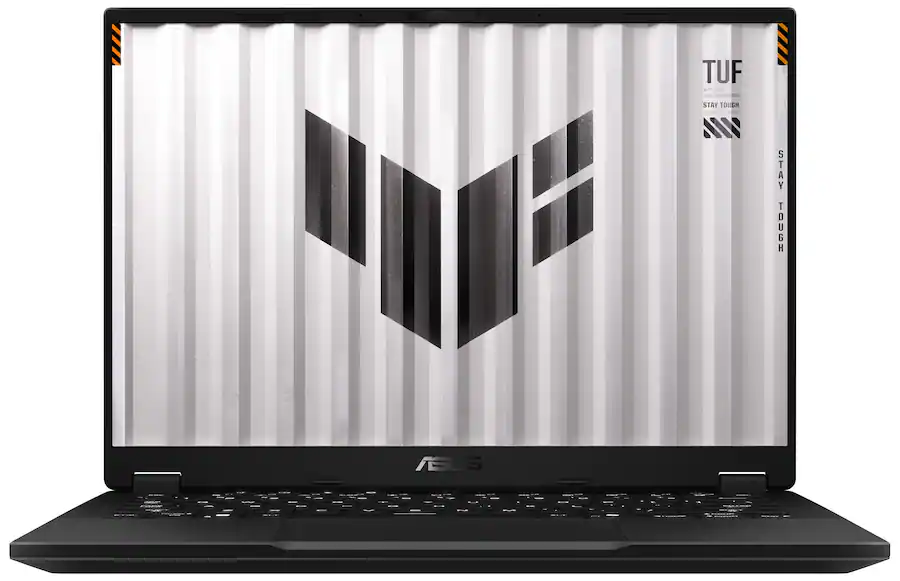
Summary: A Confusing Step Back
The new ASUS TUF A14 lands in an awkward spot. What was once a solid midrange 14 inch gaming laptop now starts around $2,200, but performance has not kept up with the price increase.
It is one of the first laptops with AMD’s Strix Halo chip, pairing a strong CPU with integrated graphics using shared memory. While promising in theory, the 32GB memory limit holds it back in practice, especially for gaming.
The result is a system that often performs worse than last year’s RTX 5060 model, despite costing more. That makes it a tough sell in a category where better performing options are already available for less.
Let’s start with gaming, since that is the primary purpose of this laptop.
The Ryzen AI Max+ 392 chip includes the full 40 core integrated GPU that comes in the highest end Strix Halo chips. In synthetic benchmarks, it performs well for an integrated solution, beating Intel’s latest integrated graphics.
However, it falls behind laptops with dedicated GPUs like the RTX 5060 found in last year’s TUF A14 and Lenovo’s LOQ 15.
Ray tracing performance is particularly weak. In Port Royal, this GPU performs the worst among its competitors, largely because it lacks dedicated ray tracing hardware and falls behind newer GPU architectures.
In real world gaming, results are mixed.
At the laptop’s native 2560 x 1600 resolution, performance struggles. In Cyberpunk, we saw around 41 FPS even with upscaling enabled. Dropping to 1920 x 1200 delivers a much better experience and is the recommended setting for smooth gameplay on this device.
At these optimized settings:
- Cyberpunk runs around 90 FPS with solid frame consistency
- Frame generation helps close the gap but still trails RTX 5060 laptops
- Marvel Rivals performs worse than expected despite a stronger CPU
- Forza Horizon 5 is a highlight, where the TUF performs very well
Another major drawback is the lack of DLSS support. Since this laptop does not use an Nvidia GPU, you lose access to one of the best upscaling technologies available today in terms of both image quality and game support.
While AMD’s FSR is available, most games still rely on older versions that do not look as clean as DLSS, which further hurts the overall gaming experience.
Overall, this laptop sits in an awkward middle ground. It is better than most integrated GPU systems but not competitive with dedicated GPU laptops in the same price range.
In practice, this puts the TUF A14 somewhere between a lower wattage RTX 4060 and RTX 5060 in most games, which is a problem when last year’s model already delivered that level of performance at a lower price.
At this price point, not outperforming last year’s model or cheaper alternatives makes this a difficult recommendation for most gamers.
Thermals and Noise: A Strong Showing
Thermals remain one of the TUF A14’s biggest strengths.
During gaming, the keyboard deck stays impressively cool. In fact, it is one of the coolest feeling laptops we have tested under load.
Fan noise is also slightly improved, though still loud in Turbo mode. Switching to Performance mode offers a much better balance, with only a small drop in performance but a significant reduction in noise.
CPU performance is where this laptop truly stands out.
Despite using a 12 core version of Strix Halo instead of the full 16 core variant, it delivers excellent multi core results. In Geekbench, it rivals high end chips from Apple, and in Cinebench it nearly matches a MacBook Pro with an M4 Pro processor.
Compared to last year’s Ryzen 7 model, this is a massive improvement.
However, this performance comes at a cost. Power draw is extremely high, peaking above 100 watts. Efficiency is not a strong point here, especially compared to Apple’s silicon or Intel’s latest chips.
Creative Workloads: Limited by the GPU
For creative applications, performance is mixed.
In Premiere Pro, the TUF A14 falls behind laptops with Nvidia GPUs, which still dominate in GPU accelerated workloads. However, it does hold its own against MacBook Pro systems in certain scenarios.
If your workflow relies heavily on GPU acceleration, this is not the ideal machine.
Battery Life: Surprisingly Good
Battery life is one of the more impressive aspects of this laptop.
During performance tasks, it retains about 90 percent of its plugged in performance, which is a major improvement over last year’s model.
For lighter workloads, it lasts over 9 hours in our updated battery test. That is solid for a gaming laptop, though some newer Intel systems still push further.
Design and Features: Familiar Strengths and Weaknesses
Part of the issue here is positioning. The TUF lineup has traditionally been ASUS’s value-focused gaming series, but this model is now priced closer to premium devices while still feeling like a budget oriented design.
The overall design is very similar to last year’s model, so most of the pros and cons remain unchanged.
Pros
- Lightweight and highly portable for a gaming laptop
- Comfortable keyboard with good key travel
- Improved trackpad with quieter clicks
- Bright matte display that handles reflections well
- Good port selection including USB C, HDMI, and microSD
- Decent speakers for its size
Cons
- IPS display instead of OLED at this price point
- Limited color accuracy for professional work
- Build quality feels somewhat cheap
- Webcam quality is underwhelming
- Slightly heavier than last year’s model
- Most importantly, worse gaming performance for a higher price
Alternatives to Consider
At this price point, there are better options depending on your needs.
If gaming is your priority, last year’s TUF A14 offers better performance at a significantly lower price.
For budget buyers, Lenovo’s LOQ with newer Intel chips delivers strong gaming performance and a larger display, though it is less portable.
And for creators or developers, a MacBook Pro at this price provides a more well rounded experience with better efficiency and build quality.
Final Verdict
The ASUS TUF A14 with Strix Halo is not a bad laptop, but one that misses the mark for its price.
You are paying more for a system that, in many cases, delivers worse gaming performance than its predecessor. While CPU performance and efficiency improvements are notable, they are not enough to offset the overall value gap.
If the price drops, this becomes a much more interesting option. Until then, there are simply better choices available.